User Research &

Usability testing

Build products users actually understand, trust, and adopt.

Talk to a UX expert

Great design decisions don’t come from opinions or

assumptions. They come from real user behaviour.

Wandr’s User Research & Usability Testing services help product teams uncover friction, validate decisions, and reduce risk before costly development or launches.

We embed research and testing directly into your product process, giving teams clarity on what works, what doesn’t, and why… so you can move forward with confidence.

What Is User Research

& Usability Testing?

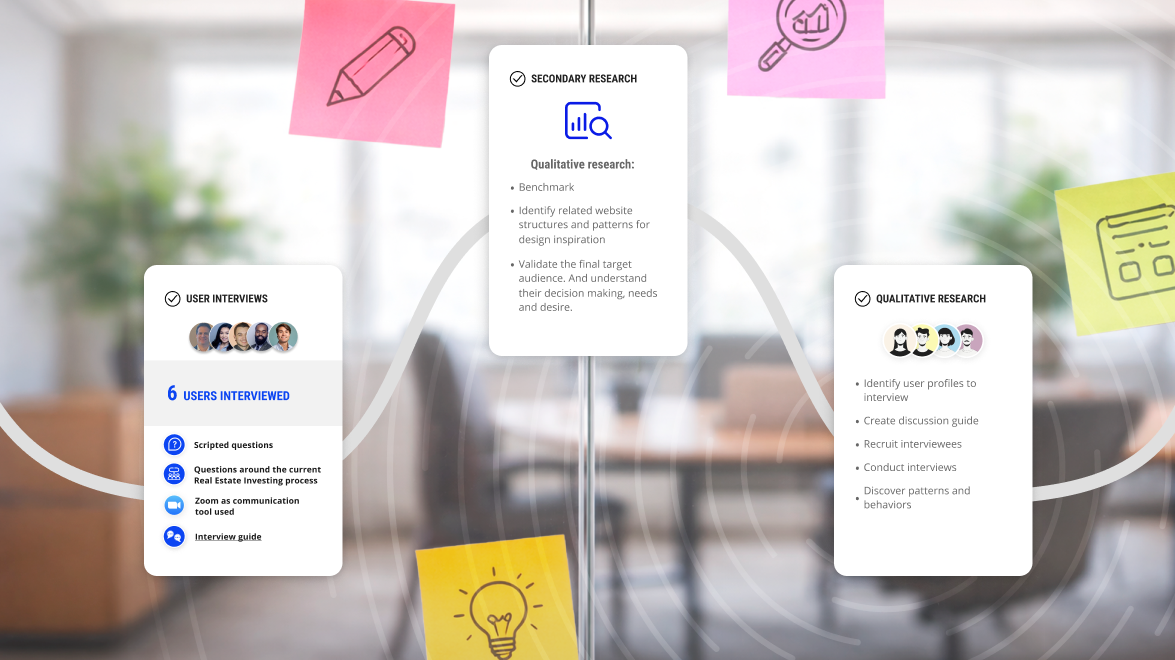
User research and usability testing are structured methods for understanding how real users interact with your product, where they struggle, and what influences their decisions.

Rather than guessing, we observe actual behaviour through interviews, task-based testing, and qualitative insights. This allows teams to validate assumptions early, refine designs quickly, and avoid building features users don’t need.

Unlike surface-level feedback, our approach focuses on behavioural evidence, not opinions, and integrates directly into product, UX, and decision-making workflows.


When user research &
usability testing add

the most value?

This service is a strong fit if:

- You’re designing a new product, MVP, or feature

- Usability issues are slowing adoption or conversion

- Stakeholders disagree on what users actually need

- You want to validate concepts before development

- You need confidence before launch or iteration

If the cost of getting it wrong is high, research and testing create focus.

Why Conducting User Research

Drives Better Business Outcomes?

Product decisions become expensive when they’re made in isolation. Without direct exposure to real users, teams risk prioritizing the wrong features, misinterpreting behaviour, or over-investing in solutions that don’t resonate. At Wandr, user research and usability testing are used to create clarity before execution. Insights are translated into priorities, trade-offs, and next steps that teams can act on with confidence.

BOOK A CALL

(01)

Reduced Product Risk

User research identifies friction, confusion, and unmet needs early, allowing teams to correct course before development time, budgets, and momentum are at risk.

(02)

Faster, More Focused Iteration

Clear research findings replace subjective debate, helping teams move forward decisively instead of cycling through revisions based on opinion or hierarchy.

(03)

Stronger User Adoption and Retention

When products are shaped by real behaviour and mental models, users understand them faster, experience less friction, and are more likely to return.

(04)

Alignment Across Teams and Stakeholders

Research creates a shared understanding that aligns product, design, engineering, and leadership around the same user realities and priorities.

(05)

Smarter Feature Prioritization

Observed user behaviour helps teams distinguish between what is essential and what is optional, ensuring effort is focused on the highest-impact work.

(06)

Greater Confidence in Product Decisions

Decisions grounded in evidence are easier to defend, easier to communicate, and easier to execute — both internally and with external stakeholders.

What You Get with Wandr’s User Research

& Usability Testing services?

Everything needed to plan, run, and apply research with real impact.

User Recruitment - We recruit the right participants based on your target personas and use cases. We handle screening, scheduling, and participant incentives.
Asterisk - Unusually Webflow Template
Test Plan & Script - We create a structured testing script aligned to your research goals and key questions. This ensures consistency across sessions and reliable insights.
Asterisk - Unusually Webflow Template
Moderated Usability Testing - We run live, moderated sessions where users complete real tasks. We observe behaviour, friction points, and decision patterns. Sessions are documented with notes and recordings.
Asterisk - Unusually Webflow Template
Insights & Analytics - We analyse session data, identify behaviour patterns, and evaluate issues by impact and frequency. Qualitative findings are grounded in observable evidence to support confident decision-making.
Asterisk - Unusually Webflow Template
Usability Summary Report - You receive a concise report with key findings, user quotes, and recommendations. The report is designed to directly inform product and design decisions.
Asterisk - Unusually Webflow Template
Our DNA —
Our DNA —
Our DNA —
Our DNA —
Our DNA —
Our DNA —

Our User Research &

Usability Testing process

01

Research Framing

& alignment

We align with your team on business goals, success metrics, product context, and constraints to define the scope and focus areas of the audit.

02

Secondary Research

& Data Review

We review existing data sources such as analytics, prior research, customer feedback, and market context to ground testing in real usage patterns and known signals.

03

User Recruitment

& Test Design

We recruit target users based on defined personas and use cases, and design a structured test script that focuses on validating assumptions and uncovering friction.

04

Moderated

Usability Testing

We run live, moderated sessions to observe real user behaviour as participants complete key tasks. Sessions are documented to capture decision points, confusion, and patterns.

05

Insights, Analytics

& Reporting

We synthesize qualitative findings with supporting data, identify patterns and severity, and deliver clear insights and recommendations teams can act on with confidence.

User Research & Usability Testing

Engagement Timeline

Timelines depend on scope. Foundational research conducted as part of a design engagement typically takes around two weeks, focused on answering immediate product and design questions. More comprehensive, standalone research can span 2-4 months, allowing for deeper exploration and broader validation. Most clients land between these extremes, choosing a level of research that balances confidence with speed.

Usability testing is not a one-time activity. It is embedded throughout our design sprints and included in all Wandr design services.

See how user research has helped teams uncover critical insights, reduce risk, and make confident product decisions.

Asterisk - Unusually Webflow Template
Frequently Asked Questions
Testimonials —
Testimonials —
Testimonials —

User Research & Usability Testing FAQs

(01) /

What are MVP development services?

MVP development services cover the end-to-end process of defining, designing, and validating a Minimum Viable Product before full-scale engineering begins. At WANDR, this includes market research, user interviews, feature prioritization, UX/UI design, high-fidelity prototyping, usability testing, and a product roadmap — all focused on validating the most critical assumptions with the least investment.

(02) /

How does MVP development services reduce the cost of being wrong?

Most teams think MVP development means building a cheaper version faster. It doesn't. The real value is what it prevents — wasted engineering cycles, misaligned features, and the compounding cost of discovering you built the wrong thing six months into development. Done right, MVP development forces the hard questions early so your team builds the right thing with confidence, not the first thing with speed.

(03) /

How long does MVP development take?

WANDR guarantees a validated, investor-ready MVP prototype within 8 weeks of kickoff — or we keep working at no additional cost until we deliver it. The only thing we ask: show up for the reviews. Timelines assume timely client feedback at each stage.

(04) /

How much do MVP development services cost?

MVP development costs vary based on scope, complexity, and the depth of research and design required. WANDR scopes every engagement individually based on your product goals and constraints. What we can say: the cost of building the wrong product is almost always higher than the cost of proper MVP development upfront.

(05) /

What is a product roadmap and why does it matter for MVP development?

A product roadmap outlines priorities, sequencing, and direction — helping product and engineering teams align around a clear plan before and after MVP launch. Without a roadmap, MVP development often stalls after initial release because teams don't know what comes next. The roadmap ensures the MVP is the beginning of a product strategy, not a one-off deliverable.

(06) /

How is MVP development different from full product development?

MVP development focuses on the smallest set of features needed to validate assumptions and generate learning — not a complete, fully-featured product. The goal is to test whether the core value proposition works before committing the full engineering investment required for a production-ready product.

BOOK A CALL —

BOOK A CALL —

WORK WITH A UX DESIGN

AGENCY that scales with you

If you’re looking for a strategic UX/UI design partner — not just a vendor — let’s talk.

get in touch

User Research & Usability Testing

Related Articles

User Research & Usability Testing

Article title

Reading time:

10 min

User Research & Usability Testing

Article title

Reading time:

10 min

User Research & Usability Testing

Article title

Reading time:

10 min